Week
of May 30, 2004
Crushing
seeds and spices releases more of their flavor.
If you do not have a molcajete being the mortar,
tejolote the pestle. [mohl-kah-HEH-teh ee
and teh-hoh-LOH-teh] You can find one at
the Mexican Grocer, Click on the Link:
Authentic Mexican kitchen
items
The
black, rough texture of both pieces is a result
of the fact that they're made of basalt (volcanic
rock).The grinding process releases the oils,
and flavor essence of the substance. When done
carefully you will produce a product that is more
flavorful than a product prepared in a food processor
and definitely more flavorful than what you buy
ground at your grocery store. The process can
be a little laborious but since the quantity of
spice is usually small, it is not a major factor
of consideration. If you enjoy cooking, using
a mortar and pestle will simply be part of your
"craft" of food preparation.
Place
the substance to be ground inside the mortar (bowl).
Sit the pestle on top of the substance and apply
downward pressure, then grind using a circular
motion. This action forces the substance against
the surface of the bowl and pulverizes it.
How
To Season or Prepare Your Molcajete Before Use
It is necessary to season
the molcajete prior to using it or you'll get
grit in your food.
1.
Wash and scrub the interior of the molcajete
and the tejolote with water and a stiff brush.
Let both objects air dry. Now proceed to steps
2 and 3. We like the combination of both methods
or you may select one or the other. This process
only needs to be done one time before actually
using your molcajete and tejolote..
2. Put a handful of uncooked rice in the
molcajete. Use the tejolote ( the pestle) and
grind the rice into the surface of the molcajete
(bowl). Discard the pulverized rice. Repeat the
process until the pulverized rice is white, rather
than gray or ash colored.
3.
Add 4 cloves of garlic (peeled), 1 teaspoon of
cumin (comino) and 1 teaspoon salt, kosher is
good, and a teaspoon of pepper. Grind the mixture
evenly around the interior of the molcajete. Remove
and discard the mixture. Rinse the molcajete and
tejolote with clear water and allow to dry before
storing. Note that these ingredients and quantities
can be adjusted to your liking and for the size
of your molcajete.
Maintenance
Wash the molcajete and tejolote in warm water
after each use. Do not use soaps or detergents
which may be absorbed into the stone and taint
your food.
Warning:
Make sure that your molcajete is made from an
authentic material not just for decoration. There
are some on the market that are made from painted
concrete and are not suitable for cooking.
Week
of May 23, 2004
Since
the grilling season is upon us, we've gathered
together approximate grilling times for Beef and
Veal, Fresh Pork, Lamb, Chicken and Poultry, Venison
and Turkey.
The times given are approximate so you have a
starting point from which to judge. Until you
become comfortable with cooking on your own specific
grill, the most accurate way to determine if your
meat is done is to measure the internal temperature
with an instant read thermometer. The thermometer
should be inserted into the thickest part of the
meat, away from the bone, for a true reading.
Fish
is different. There is not a temperature guideline
because of the difference between types of fish.
During cooking the fish will turn from translucent
to opaque. When done, a toothpick inserted in
the thickest portion should meet no resistance
and come out clean when you remove it from the
fish.
| Cut |
Heat |
Time |
Temperature |
| Steak
3/4 inch thick |
High/Direct |
3
to 5 minutes side |
145
degrees F |
| Steak
1 1/2 inch thick |
High/Direct |
7
to 8 minutes side |
145
degrees F |
| Kabobs
1 inch cubes |
High/Direct |
3
to 4 minutes side |
145
degrees F |
| Sirloin
Patties 1/2 inch thick |
High/Direct |
3
minutes side |
160
degrees F |
| Sirloin
Tip 3 1/2 - 4 pounds |
High/Direct |
25
minutes pound |
145
degrees F |
| Veal
Steaks/Chops 1 inch thick |
High/Direct |
5
to 7 minutes side |
145
degrees F |
| Pork
Chops 3/4 inch thick |
High/Direct |
3
to 4 minutes side |
160
degrees F |
| Pork
Chops 1 1/2 inch thick |
High/Direct |
7
to 8 minutes side |
160
degrees F |
| Pork
Tenderloin 1/2 - 1 1/ 2pounds |
High/Direct |
7
to 12 minutes side |
160
degrees F |
| Lamb
Chops or Steaks 1 inch thick |
High/Direct |
4
minutes side |
145
degrees F |
| Lamb
Kabobs 1 inch cubes |
High/Direct |
4
minutes side |
145
degrees F |
| Lamb
Patties 1/2 inch thick |
High/Direct |
3
minutes side |
160
degrees F |
| Whole
Fryer |
Medium/Indirect |
60
to 75 minutes |
180
degrees F |
| Cornish
Hens 18 to 12 ounces |
Medium/Indirect |
45
to 55 minutes side |
180
degrees F |
| Chicken
Breast Bone In |
Medium
High/Direct |
10
to 15 minutes side |
180
degrees F |
| Boneless
Chicken Breast |
High/Direct |
6
to 8 minutes side |
180
degrees F |
| Chicken
Legs or Thighs |
Medium
High/Direct |
10
to 15 minutes side |
180
degrees F |
| Chicken
Drumsticks |
Medium
High/Direct |
8
to 12 minutes side |
180
degrees F |
| Venison
Leg Roast |
Medium/Indirect |
25
- 30 minute pound |
145
degrees F |
| Venison
Steak 1/2 inch thick |
High
/ Direct |
4
to 5 minutes side |
145
degrees F |
| Venison
Steak 1 1/2 inch thick |
High
/ Direct |
6
to 7 minutes side |
145
degrees F |
| Turkey
Breasts 6-8 ounces |
High
/ Direct |
10
to 15 minutes side |
180
degrees F |
| Turkey
Thighs/Drumsticks 8-16 oz. |
High
/ Direct |
10
to 15 minutes side |
180
degrees F |
| Boneless
Turkey Roll 2-5 pounds |
Medium/Indirect |
1
1/2 to 2 hours |
180
degrees F |
| Boneless
Turkey Roll 5-10 pounds |
Medium/Indirect |
2
to 3 1/2 hours |
180
degrees F |
Happy
Grilling!
Week
of May 16, 2004
This
French term "En Papillote" for cooking
in paper not only saves on clean up, but is an
attractive and classical presentation technique.
However
many of you have written in saying that you were
having a hard time making the envelope or package.
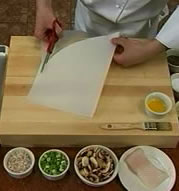
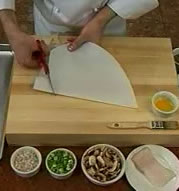
Here are some photos that may help.
Start
by folding a length of parchment paper (not wax
paper) to form a square or boxy rectangle; then
cut along one side to form a heart shape (just
like you used to do in elementary school to cut
out valentines).
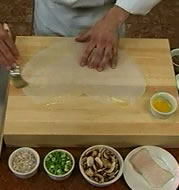
Oil
both the left and right sides of the "heart"
(using a pastry brush works or you can use lightly
spray edges with cooking oil spray).
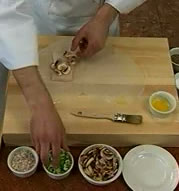
Add
your ingredients. In the photo, the chef is using
a fish fillet, mushrooms, green onions and chopped
garlic.
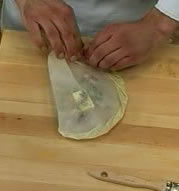
Fold over and crimp about an inch at a time along
the open edge from top to bottom. Make sure to
double crimp the last fold.
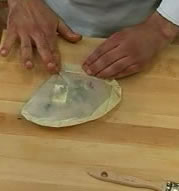
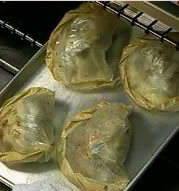
Place
the sealed bags in a hot oven and remove once
the paper has puffed up and become brown on top
and around the edges.
Week
of May 9, 2004
What
is calcium?
Calcium is the most abundant mineral in your body.
It is very important for:
- bone
health
- teeth
- nerve
function
- muscles
- blood
clotting
If
you do not get enough calcium in your diet you
may be at risk for losing calcium from your bones,
making them thinner and weaker. This condition
is called osteoporosis.
How
much calcium do you need ?
How much calcium you need depends on your age
and whether you are male or female.
The
recommendations are:
GROUP
Children
Teenagers and Young Adults
Premenopausal Women - 25 to 50 years old
Women 25 to 50 years old
Pregnant and breast-feeding women
Women over 50 years old (postmenopausal)
Taking
Estrogen
Not
taking Estrogen
Women over 65 years of age
Men 25 to 65 years of age
Men over 65 years of age
|
MG
CALCIUM/DAY
800
1200 to 1500
1000
1000
1200 to 1500
1000
1500
1500
1000
1500 |
| |
|
What
are good sources of calcium?
Dairy products are one of the best sources of
calcium. Calcium may also be found in a variety
of other foods, as listed in the following table.
Fat content (regular, low fat or fat free does
not affect the calcium).
| FOOD
|
SERVING
SIZE
|
MG
CALCIUM (APPROXIMATE) |
| Milk,
whole, 2%, 1%, or skim
Yogurt
Cheddar Cheese
Ice Cream
Frozen Yogurt
Cottage Cheese
Tofu
Soy Milk, unfortified
Greens (collard, kale, mustard)
Red beans, chickpeas
Sardines (with bones)
Salmon, canned
Molasses, blackstrap
Corn tortillas
Seaweed, dry |
8
ounces
1 ounce
1 ounce
1/2 cup
1/2 cup
1/2 cup
4 ounces
8 ounces
1/2 cup
3/4 cup
3 ounces
3 ounces
1 Tablespoon
2
1/2 cup |
300
300
200
100
100
90
250
80
80 to 150
60
350
180
125
90
100 |
Many
brands of orange juice, cereal, and bread are
fortified with extra calcium. Check the labels.
If
you can get enough calcium in your diet, you do
not need to take calcium supplements. Dairy products
are the easiest source of calcium. It is hard
to get enough calcium if these products are not
a part of your diet. If you can not eat dairy,
it is best to take a supplement.
Week
of May 2, 2004
Spring
is here and fresh asparagus is now in season.
The price dramatically drops in grocery stores
across the country, so that mere mortals can once
again enjoy this luscious delicacy without pocketbook
guilt.
There
are three types of asparagus: purple, green or
white. The green asparagus is the most common
and what you will find in your market. This type
usually has a green stem and a green-purple tip.
Steaming
is the classical method of preparing asparagus
- often served hot with a small bit of butter
or margarine to coat or cold served with a vinaigrette
dressing. But the bold cook will want to experiment
with the vegetable in everything from soups, salads,
Thai entrees, creamy risottos to soufflés.
Die hard asparagus fans who fancy the unadulterated
flavor will probably say, don't mess with a good
thing.
The
golden rule is to avoid storing or cooking for
too long, cooked heads should be firm (not bending
when held from the base) but not so firm as to
be crunchy or leathery when eaten. The quality
of asparagus deteriorates quickly with age. It
should be cooked within three days of cutting.
Select ones with no more an inch or so of the
tough woody base that will need trimming. They
usually can be purchased in one pound bundles.
The most tender spears are usally not too thin
or not too thick.
To
prepare for steaming, wash the spears and then
snap off tough base ends and place in cold water.
If your asparagus appears to be a little tough,
it may be best to peel the stalk with a sharp
knife or potato peeler. This will always produce
a really tender stalk.
The
next step is to tie them into a bundle with soft
kitchen string or twine. Tie one band close to
the base and the other just below the tip. Make
sure the ends at the base are level (tips to the
other side). Place and support the bundle upright
in a pan of boiling salted water - tips must be
well above the level of the water. I find that
a tall narrow stockpot works well. Cover the pan
and boil gently for 10 to minutes or just until
crisp / tender and still bright green in color.
Drain carefully and serve with a dash of lemon
zest and a tablespoon of low saturated fat margarine.
Other
ways of cooking asparagus are to microwave it,
poach in water and dump into a cold bath, pan
roast it with a little olive oil spray, stir fry
it or roast it in a 450 degree oven with a little
olive oil. It only takes a few minutes until they
are crisp / tender, so check spears after four
minutes.
Here
is the best part; asparagus is a great source
of folic acid, vitamin C and carotenoids. And
for all you fat, calorie and carbohydrate watchers
out there, this is a great diet food.
1/2
cup Cooked Asparagus = 20 calories, 0.20g
fat, 2.16g protein, 1.8g fiber,
3.70g carbohydrates, 13mg sodium
or, if you want the breakdown in spears . . .
4 spears Cooked Asparagus = 13 calories,
0.13g fat, 1.44g protein, 1.2g fiber,
2.47g carbohydrates, 8mg sodium
For
a change of pace try the
Asparagus with Red Pepper Sauce