Week
of February 26, 2010
Fantastic
Chicken Broth
1
pound boney chicken parts
1 large onion
3 ribs celery
1 carrot
1 teaspoon salt (or less - you can add more later
to taste)
3 whole cloves
1 dried bay leaf
6 cups water
Quarter
onion. Chop scrubbed celery and carrot into 1
inch chunks. Place chicken pieces, onion, celery,
carrot, salt, cloves and bay leaf in large soup
pot or Dutch oven. Add 6 cups water. Bring to
a boil. Reduce heat, cover, and simmer for 1 to
2 hours.
Remove chicken and vegetables. Strain stock. Cool
in refrigerator. Skim fat off the surface.
Freeze
it in an ice cube trays, then store in freezer
bags. Then you'll have individual portions that
are ready to go for a quick sauces and soups.
Week
of February 19, 2010
How
to Make a Hearty Vegetable Stock
4
medium carrots, peeled and cut into chunks
2 stalks celery, tough strings peeled,stalks cut
into chunks
2 medium onions, roughly chopped
1 leek, halved lengthwise and washed thoroughly
2 cloves fresh garlic
2 1/4 quarts water
Black Peppercorns and a Bay Leaf (Optional)
In
a large pot, combine all ingredients. Bring to
a boil. Reduce heat to a simmer and cook for 25
minutes.
Strain stock and reserve for soups and sauces.
COOKS
NOTE: Stock may be made ahead of time and frozen
for a quick soup base.
For
a richer and and more full bodied vegetable stock,
try adding shiitake mushrooms to the above vegetables
and then roast vegetables in the oven in a little
olive oil until browned. Then add water to the
vegetables and in a soup pot or Dutch oven and
bring to a boil and simmer for at least 30 minutes.
Week
of February 12, 2010
Do
you love tarts, but are looking for a way to lighten
them up? Try using meringue cups - they are light,
airy with a slightly sweet crunch. Fill them with
fruit, pudding, flavored frozen yogurt and top
with your favorite sauce.
Picture Perfect Meringue Cups
Makes 8 Meringue Cups
1
1/2 cups sugar
2 tablespoons cornstarch
6 large egg whites, room temperature
1/4 teaspoon cream of tartar
Position 1 rack in bottom third and 1 rack in
top third of oven; preheat to 200°F. Line
2 large baking sheets with parchment paper. Trace
with a heavy hand, 4 circles approximately 3 1/2
inches in diameter on each parchment sheet. Turn
parchment over so that marked side faces down
(if you have traced heavily enough, the circles
will show through to the other side).
Whisk sugar and cornstarch in medium bowl to blend.
Using an electric mixer on medium-high speed,
beat whites in large bowl until foamy, about 1
minute. Add cream of tartar; beat until soft peaks
form, about 1 minute.
Add sugar mixture, 1 tablespoon at a time, beating
until whites are very stiff and glossy, at least
4 minutes with heavy-duty mixer and 6 to 8 minutes
with handheld.
Scoop enough meringue into pastry bag fitted with
medium star tip to fill 3/4 full. Pipe small dot
of meringue under parchment in each corner of
baking sheets. Press parchment onto dots. This
will keep the parchment lying flat.
Starting in center of 1 marked circle, pipe meringue
in continuous spiral to fill circle completely.
Pipe 1 meringue circle atop edge of base circle,
forming a standing rim.
Repeat, piping 2 more circles atop first, forming
meringue cup. Pipe 3 more cups on sheet, filling
bag with meringue as needed. Pipe 4 cups on second
sheet.
Bake meringues 3 hours without opening oven door
(meringues may drop slightly). Turn off oven;
let meringues stand in closed oven over-night
to dry completely. Store in an airtight container.
Do not stack.
Per
Serving: 166 Calories; trace Fat (0.0% calories
from fat); trace Saturated Fat; 3g Protein; 40g
Carbohydrate; trace Dietary Fiber; 0mg Cholesterol;
42mg Sodium. Exchanges: 0 Grain (Starch); 1/2
Lean Meat; 0 Fruit; 2 1/2 Other Carbohydrates.
Week
of February 05, 2010
Try
something different - Quinoa
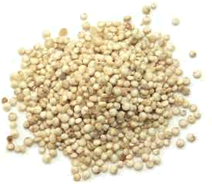
Quinoa,
pronounced keen-wah, is not a true cereal
grain, but rather the botanical fruit of an herb
plant. It is treated as a grain in cooking even
though it is the seed of a leafy plant that's
distantly related to spinach. Quinoa, a delicately
flavored grain that was a staple in the ancient
Incas' diet. Quinoa has a light, delicate taste,
and can be substituted for almost any other grain.
It is higher in unsaturated fats and lower in
carbohydrates than most grains, and the quality
of its protein is roughly equivalent to that of
milk. Quinoa cooks quickly, making it perfect
for weeknight pilafs and hearty grain salads
Most
quinoa is imported from South America, although
it is being cultivated on the high slopes of the
Colorado Rockies. Quinoa
grains are about the same size as millet, but
flattened, with a pointed, oval shape. The color
ranges from pale yellow through red and brown
to black. Quinoa cooks quickly to a light, fluffy
texture. As it cooks, the external germ, which
forms a band around each grain, spirals out, forming
a tiny crescent-shaped "tail," similar
to a bean sprout. Although the grain itself is
soft and creamy, the tail is crunchy, providing
a unique texture to complement quinoa's delicate
flavor.
Since
this grain is still a relatively new one, at least
to the American market, you're most likely to
find it in health-food and specialty stores. Large
supermarkets often stock quinoa, too.