Week
of February 29, 2004

For
those who still haven not tried jicama, it is
a vegetable, that is somewhat homely in appearance.
It's lovely crisp texture with just a hint of
sweetness, more than makes up for any exotic appearance.
Also
called a Mexican potato, jicama comes from Central
America and Mexico where it is a staple. Like
potatoes, jicama grows underground as a tuber.
Covered with a thin brown skin, it has a short
root attached. Inside, you'll find white flesh
that looks like an apple or raw potato. The flesh
is sweet, juicy and crisp, perfect as a snack
vegetable or used in salads. Cooked lightly it
becomes milder but retains its crispness, like
a water chestnut.
Sliced
into wide sticks, jicama makes a crunchy carrier
for guacamole and highly seasoned dips. Cut up
into squares, it enhances fresh fruit salad, absorbing
and reflecting surrounding flavors. It is equally
versatile as a cooked vegetable - sauteed with
carrots or green beans, stir-fried with chicken
or shrimp, or simmered in savory stews. Low in
starch, fat and calories, jicama is satisfying,
flavorful and nowhere near as odd as it looks.
1
cup of jicama sliced has 46 Calories; 0.11g Fat;
0.03g Saturated Fat; 0mg Cholesterol; 4.80mg Sodium;
10.58g Carbohydrates; 5.88g Dietary Fiber; 0 Sugars,
0.86g Protein
Week
of February 22, 2004

1.
Nuts, seeds, and herbs are often toasted before
being added to any dish. It will enhance the taste
and aroma for a more flavorful dish without having
to use as much.

2. To ensure there is even toasting, it is important
to keep the pan over medium heat and to use constant
motion until the nuts or seeds are toasted to
a golden brown. Cool slightly before adding to
your recipe.
Week
of February 15, 2004
How
to use meat rubs

1.
Coating meats with a dry rub, is a fairly quick
way to infuse the flavor of the spices into the
meat prior to cooking.
Create
a mixture of dry herbs and crush them in a mortar.

2.
Lightly rub or spray the meat with a very small
amount of oil,

3.
then generously coat the entire outside with the
blend of spices and herbs.

4.
Cover with plastic wrap and allow it to sit for
at least an hour and up to 24 hours under refrigeration.
The meat is now ready to be cooked.
Week
of February 8, 2004
Flavor
it Up - Bouquet Garni
Bouquet
Garni is a French term used for a bundle of herbs.
It can be made from fresh or dried ingredients.
For a fresh, use 3 sprigs of parsley, 1 small
sprig of thyme leaves and 1 small bay leaf.
It
is ok to use 1 dried bay leaf in the fresh bouquet
garni. Tightly tie the bundle together using string
or wrap securely in cheese cloth and tie. Use
in soups, stews and sauces. Remove before serving.
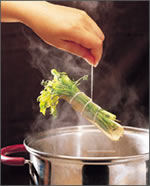
Tie
in a Bundle
OR

Wrap in Cheesecloth and Tie with Twine.
A
dried bouquet garni is made from dried bay leaves,
parsley, and thyme leaves. Mix together 1 table-spoon
of each herb and place one or two teaspoons in
a piece of cheesecloth or a metal tea ball.
Add
to the beginning of cooking and take out before
serving. If using with fish, add dill weed for
added flavor. If you use cheese cloth, add one
of the following: orange peel, cloves, fennel
leaves, celery leaves, majoram or peppercorns.
Be
creative, you can create a bouquet garni from
just about any herbs you'd like. The bouquet garni
is especially handy for herbs such as bay leaves,
which should always be removed before serving.
Week
of February 1, 2004
Pan
Sautéing or Stir Frying

When
you do use oil for sautéing or stir frying,
it is important to have the oil in the pan preheated
before adding any of the ingredients. Food will
absorb too much oil if it is not sizzling when
placed in the pan. Notice how the oil moves in
the pan before food is added. This is a good indication
that it is getting hot.